Between crisis and change: Pollutants, health and ecosystems in the Anthropocene
September 2nd-4th, 2026
Eat
Call for Abstracts
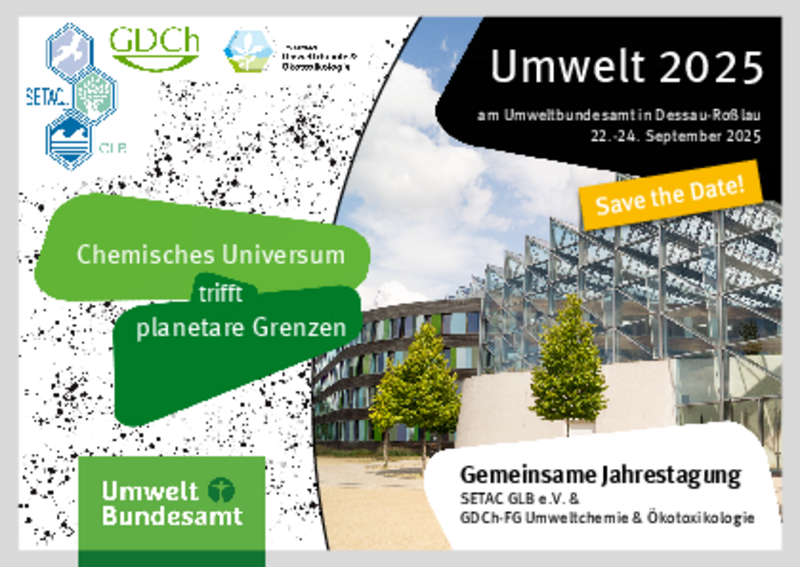
The chemical universe meets planetary boundaries. The annual meeting of the GDCh Division of Environmental Chemistry and Ecotoxicology and SETAC GLB took place from September 22nd to 24th, 2025, at the headquarters of the German Federal Environment Agency (UBA) in Dessau-Roßlau. The Conference addressed the problem that while our modern life is inconceivable without chemical substances and their diverse applications, their release into the environment has far-reaching consequences. From the increasing concentrations of persistent pollutants in soils and water to atmospheric pollution, chemical substances contribute to disrupting the Earth's natural balance with potentially irreversible consequences for both humans and the environment. The focus was on how to jointly develop sustainable solutions.
Flyer
program
From the lecture hall to practice & from the laboratory to the field scale. "Umwelt" is the joint annual conference of the GDCh Division of Environmental Chemistry & Ecotoxicology and the SETAC GLB. The 2024 edition took place from September 8 to 11, 2024, in Gießen and Homberg (Ohm). Non-members were welcome, as always. In addition to traditional lecture hall sessions, there was a field day, as was the case 10 years ago, where methods were demonstrated and discussed in practice. Participants were also welcome to present their own methods.
Flyer
Conference proceedings
Together against global environmental pollution: Education and research for clean solutions. What effects do different chemicals have on people, organisms, and entire ecosystems? To answer this question, suitable methods must be developed, optimized, and applied to achieve reliable results at various levels. Based on this data, risk assessments are conducted and communicated – with the goal of preventing or remediating damage. However, a sober examination of the past and the current global situation raises doubts as to whether our current approaches will be sufficient in the future to prevent further negative effects and enable action that is adequate across the globe. To make this possible, applied solutions must be developed in collaboration with all stakeholders. As the degree of global interconnectedness and complexity increases, so does the need for integrated thinking and inter- and transdisciplinary collaboration to offer appropriate solutions. In this spirit, the joint annual conference of SETAC-GLB and the GDCh Division of Environmental Chemistry & Ecotoxicology 2023 in Muttenz was dedicated to unity: We want to promote networking and training of experts so that sustainable solutions to global environmental pollution are our future.
Flyer
Conference proceedings
Outside and Inside. After two years without in-person meetings, the annual conference of the Environmental Chemistry & Division took place from September 5th to 7th, 2022, at the Emden/Leer University of Applied Sciences in Emden, under the motto "Outside and Inside - Material Cycles in Air / in the Sea / on Land." The scientific program was once again jointly organized by the GDCh Division of Environmental Chemistry & Ecotoxicology and the SETAC GLB. The Conference focused on material cycles; "Outside and Inside" means something like "Outside and Inside."
Flyer
Conference proceedings
Under the motto " Anthropogenic Substances in a Changing World – Assessment in the Context of Reality, " the Environment 2021 Conference took place virtually on September 7-8, 2021. The scientific program was jointly organized by the GDCh Division of Environmental Chemistry & Ecotoxicology and the SETAC GLB.
Flyer
program
Due to the Corona pandemic, the 2020 Environment Conference unfortunately had to be cancelled or postponed to 2021.
Biodiversity in Water and on Land – The Role of Chemical Stressors. The biodiversity crisis is on everyone's lips, and news bombards citizens almost daily: fungal diseases are wiping out amphibians, wind turbines are killing birds of prey, invasive species are endangering native flora and fauna. Chemicals are also in focus here. Neonicotinoids are suspected of contributing to the decline of bees, PCBs are accumulating in charismatic mammals, and glyphosate has even been detected in humans. However, the questions about the role of chemical stressors in the multiple stress context and how significantly they actually contribute to the decline of biodiversity in water and on land are barely addressed in the media. Furthermore, they are far from being clearly resolved in scientific discourse. The Conference was dedicated to these topics.
Flyer
Conference proceedings
The Environment 2018 conference was organized at the University of Münster with the support of the Division and the SETAC GLB. The Conference topics included new analytical techniques and methods and their applications in the context of environmental chemistry and ecotoxicology; the occurrence and behavior of pollutants and trace substances in surface and groundwater, soils, sediments, and air; their accumulation, transformation, and effects on terrestrial and aquatic organisms, taking into account various mechanisms of action and test procedures; and concepts of assessment and regulation (e.g., the reassessment of PAHs in the amendment to the Federal Soil Protection Act).
Flyer
program
Annual Conference 2016 with SETAC GLB: "Many substances – big risk?"
How relevant are trace substances for humans and the environment? This question was the focus of the interesting specialist event. The Division specifically organized the session: "Coal and carbonaceous substrates - environmental behavior and pollutant binding."
Flyer
program
15th EuChemS International Conference on Chemistry and the Environment
The most important Conference on environmental chemistry and ecotoxicology, the ICCE (2013 in Barcelona, 2011 in Zurich and 2009 in Stockholm) took place in Leipzig in 2015 with the participation of the Division and replaced the separate annual conference.
"Research fundamentals, apply findings, impart knowledge"
“Courage to take risks” must have been the guiding principle of the hosts of this year’s annual conference on environmental chemistry and ecotoxicology in Gießen, Prof. Rolf-Alexander Düring and Prof. Klaus Peter Ebke, when they decided to deviate from the previous conference concept, which relied exclusively on lectures and posters, and to include a day for practical demonstrations in the form of field sessions. Their courage was rewarded with a very positive response from the nearly 300 registered participants.
Flyer
Conference proceedings
The planned annual meeting of the GDCh Division in Wuppertal had to be cancelled at short notice due to insufficient registration numbers. The Board of the Division was therefore very grateful that their colleagues in Essen spontaneously offered to accommodate the GDCh members who had registered their contributions for Wuppertal. This allowed the additional GDCh contributions to compensate for the slightly decreased number of registrations at the SETAC GLB conference.
From September 10-13, 2012, more than 200 scientists met for the 5th joint annual meeting of SETAC GLB and the GDCh Division of Environmental Chemistry and Ecotoxicology at the Helmholtz Centre for Environmental Research (UFZ) in Leipzig, which was held under the motto “Recognizing, Investigating, Modeling – On the Benefits of Understanding”.
Flyer
Conference proceedings
Participation in the 13th European Environmental Chemistry Conference of EuChemS, ICCE
Instead of a conventional annual conference or a joint Conference with SETAC, the Division took part in the 13th European environmental chemistry Conference of EuChemS, ICCE, in 2011. The main organizer of the ICCE is the Division of Chemistry and the Environment of EuChemS. Thomas Knacker and Gerhard Lammel were members of the Organizing Committee on behalf of the Division . In 2011, this conference was the European version of the annual conference.
4th Joint Annual Conference with SETAC-GLB: Environment 2010 – From Knowledge to Decision
For the first time, a government agency, the German Federal Environment Agency (UBA), took over the organization of the conference and proved that it is just as capable of handling this task as the previous academic organizers. The Conference also saw the awarding of the Division 's publication prize. To put it simply: the local organizing committee proved its competence, which, given the approximately 350 participants and around 100 presentations, could not have been easy. This success was due not only to the exemplary organization and the diverse supporting program, but also to the inspiring atmosphere of the conference venue – the UBA's headquarters in Dessau.
Following the broad scope of the conference, approximately 70 presentations and over 60 posters addressed many aspects of the input, behavior, and effects of chemicals in water, soil , and air. The main topics that emerged were "Monitoring and Measurement Networks," "Environmental Specimen Banks," "atmospheric chemistry, Tropospheric Aerosols," "Soil Pollution," and "Environmental Analytics."
3rd Joint Annual Meeting of SETAC-GLB and GDCh Division of Environmental Chemistry & Ecotoxicology: "New Problem Substances in the Environment – Detection, Effects, Solutions"
The overarching theme of this year's Conference was "New Problematic Substances in the Environment – Detection, Effects, and Solutions." The focus was on substances such as pharmaceuticals, perfluorinated chemicals, pesticides , and nanoparticles. "New problematic substances" are defined as substances that have either only recently entered the environment or have been present for decades and have only recently been recognized as problematic. The 300 participants from both societies impressively demonstrated the importance of this topic.
"From chemodynamics in ecosystems to substance assessment. Methods, concepts and assessments in the service of sustainable development"
The annual conference covered a broad spectrum of topics, from material transformations in individual environmental compartments to material assessment, and from local to global issues. In approximately 60 lectures and nearly 70 poster presentations, the 180 participants introduced and discussed methods, concepts, and assessments. The scientific committee, Chair by Prof. Dr. Michael Matthies of the Institute for Environmental Systems Research at the University of Osnabrück, was responsible for the program.
The Division conference took place at the Martin Luther University Halle-Wittenberg. Unlike previous years, it was not a gathering of several Divisions or a lecture block within the GDCh Annual Meeting, but rather an independently organized event. The range of topics was broad, aiming to encompass as many current developments as possible in the fields of environmental and pollutant research, sustainable chemistry, and consumer protection. The guiding theme, "Modern Man in the Ecosphere and Technosphere," continued the tradition of earlier events.
2nd Joint Annual Conference with SETAC-GLB: "Finding Boundaries, Overcoming Boundaries - Molecular Mechanisms and Ecosystem Processes"
The varied and interdisciplinary program with 85 posters and 75 lectures offered a comprehensive overview of current environmental pollutant research and attracted 280 participants to the imperial city of Aachen. It was pleasing that the Dutch scientific organizations KNCV-MC (Royal Dutch Chemistry Society - Environmental Chemistry Section), VVM (Netherlands Association of Environmental Professionals), NVT-MT (Dutch Toxicology Society - Environmental Toxicology) and the European association FECS (Federation of European Chemical Societies and Professional Institutions) also participated in the design of the conference program. 30 scientists from other European countries also took part in the mixed English and German language Conference .
Chemistry, toxicology and Environment
Under the umbrella of the GDCh Annual Conference 2003 in Munich, the Division was involved in the content design of three half-days (Tuesday afternoon and Wednesday morning and afternoon). The event was held under the motto "Chemistry, toxicology and the Environment" in order to include current developments in the field of molecular toxicology and at the same time to take into account the current discussion within the Division on a stronger integration of toxicological issues and their connection to environmental chemistry .
1st joint annual conference with the Society of Environmental Toxicology and Chemistry (SETAC, German Language Branch): "Research and development in the service of environmental and consumer protection"
In addition to overview lectures, a large number of lectures and posters on the following topics were presented at the annual meeting: ecosystem and material flow analysis/modeling, consumer protection/ toxicology, aquatic and terrestrial systems (environmental monitoring, biocidal chemicals, ecotoxicological test systems), atmosphere/climate, risk assessment/risk minimization as well as sustainable chemistry, technology and education.
This page has been machine translated. If you have any feedback or comments please feel free to contact us. 
last modified: 16.07.2026 15:29 H from Translator